Service
Electrical Panel Upgrade and Replacement
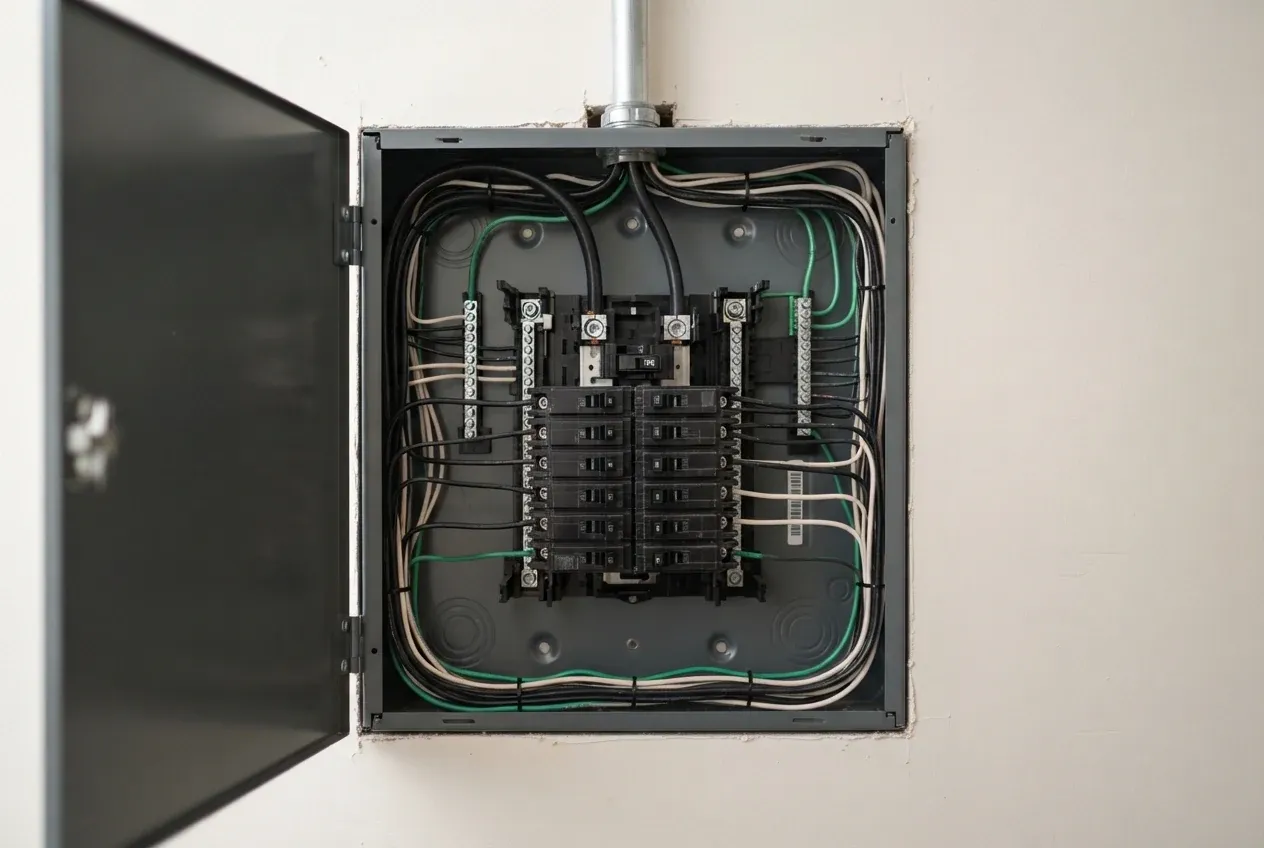
The panel is the point where utility power becomes your home's electrical system. When it is undersized, obsolete, or failing, everything downstream is limited by it.
Get connected
Free to use. We route your call to an independent licensed electrician who covers your ZIP code.
What the panel actually does
Your electrical panel takes the utility supply and divides it into the individual circuits that feed your home. Each breaker protects one circuit by interrupting current when it exceeds a safe level. The panel also provides the grounding and bonding connection that gives fault current a deliberate path back to source.
That means the panel imposes a hard ceiling. If the service is rated at 100 amps, no amount of work downstream lets you draw more than 100 amps. If breakers are old and slow to trip, every circuit in the house is protected by a device that may not act when it should.
Upgrade versus replacement
These are related but not identical. A replacement swaps a failing or obsolete panel for a modern one at the same service capacity. An upgrade increases the capacity, which usually also means new service entrance conductors, a new meter base, and coordination with the utility.
Homes with a fuse box, a documented-defect panel, or corrosion damage need replacement regardless of capacity. Homes adding significant load, vehicle charging in particular, often need a genuine capacity upgrade.
A common sequence
Panel work frequently uncovers other things. Transferring circuits exposes the branch wiring, and in homes built during the aluminium branch wiring window of roughly 1965 to 1973, that can mean discovering connections that need remediation. Grounding and bonding in older homes often does not meet current requirements. None of this is a reason to avoid the work, but it is a reason to expect the scope to be assessed properly before a fixed price is quoted.
Signs you may need this
- 01The home still has a fuse box rather than circuit breakers
- 02Service is rated at 60 or 100 amps and the household demand has grown
- 03Breakers trip regularly under normal use rather than occasional overload
- 04There is no room left for new circuits, or tandem breakers fill every slot
- 05The panel is a make with documented safety issues, such as Federal Pacific Stab-Lok or Zinsco
- 06Rust, corrosion, moisture staining, or heat discolouration inside the enclosure
- 07You are adding a large load such as an EV charger, heat pump, or electric range
Common problems
What actually goes wrong
Insufficient service capacity
A 60 or 100 amp service was adequate when homes ran a fridge, a few lights, and a television. Modern households add induction cooking, heat pumps, and vehicle charging. When total demand approaches service capacity, the main breaker trips and no amount of rewiring downstream fixes it.
Obsolete panels with known defects
Certain panel makes have documented histories of breakers failing to trip on overload. Federal Pacific Stab-Lok and Zinsco are the most cited. Replacement is usually recommended rather than repair, because the fault is in the design of the breaker-to-bus connection.
No available circuit slots
A full panel forces compromises: tandem breakers where they are not permitted, or multiple loads on one circuit. Both create conditions that trip breakers or overheat conductors.
Corroded or heat-damaged bus bars
Moisture ingress and long-term loose connections produce corrosion and heat marking on the bus. This raises resistance, which produces more heat, which worsens the corrosion. It does not improve on its own.
Double-tapped breakers
Two conductors landed on a breaker designed for one is a common finding in homes that have been added to over the years. It is a loose-connection and overload risk, and often a sign the panel ran out of capacity some time ago.
How the work usually goes
- Step 01
Load assessment
The electrician calculates your actual and anticipated demand rather than guessing. This determines whether 100, 150, 200 amps or more is appropriate.
- Step 02
Panel and service inspection
The existing panel, service entrance, meter base, and grounding and bonding arrangement are examined. Sometimes only the panel needs replacing; sometimes the service conductors and meter base do too.
- Step 03
Permit application
Panel and service work requires a permit in essentially every jurisdiction, and an inspection afterwards. Your electrician handles the filing.
- Step 04
Utility coordination
Replacing a panel means disconnecting the service. The electrician arranges the shutdown and reconnection with your utility, which usually sets the schedule.
- Step 05
Replacement and circuit transfer
The new panel is installed, circuits are transferred and labelled properly, and grounding and bonding are brought up to current code.
- Step 06
Inspection and sign-off
The jurisdiction inspects the work before the installation is considered complete. Keep this documentation. It matters when you sell.
Read this first
Safety
considerations
- 01
Panel work involves conductors that remain live even when the main breaker is off. The service lugs are energised until the utility disconnects. This is not DIY work under any circumstances.
- 02
Never remove the panel deadfront cover to investigate a problem yourself.
- 03
If you see rust, moisture, or scorching inside the panel, stop using high-draw appliances on those circuits until it is inspected.
What affects the cost
We do not
publish prices.
Electricians in the network set their own rates. Quoting a figure on someone else's behalf would not be honest. These are the factors that move the number.
- 01The service capacity you are moving to, since 200 amp costs more than 150
- 02Whether the meter base and service entrance conductors also need replacing
- 03Whether the service is overhead or underground
- 04Panel location and how accessible it is
- 05Local permit and inspection fees, which vary widely between jurisdictions
- 06Whether grounding and bonding need bringing up to current code, which is common in older homes
- 07Any aluminium branch wiring found during the transfer that needs remediation
Straight answers
Electrical Panel Upgrade questions
How do I know whether I need 100, 150, or 200 amps?
A licensed electrician performs a load calculation based on your home's square footage, heating and cooling equipment, cooking appliances, water heating, and any planned additions like an EV charger. It is a defined calculation, not a rule of thumb. Many homes with modern loads land at 200 amps, but oversizing costs money for no benefit, which is why the calculation matters.
Does a panel upgrade require a permit?
Yes, in effectively every jurisdiction in the United States. Panel and service work is permitted and inspected because it sits at the boundary between the utility supply and your home. An electrician who suggests skipping the permit is proposing something that will complicate your home sale and may void insurance claims.
How long will my power be off?
Typically most of a working day, though it depends on the scope and on your utility's disconnect and reconnect scheduling. If the meter base and service conductors are being replaced as well, it can extend further. Your electrician should tell you the expected window in advance so you can plan.
My panel is a Federal Pacific. Is that actually a problem?
Federal Pacific Stab-Lok panels have a documented history of breakers failing to trip during overload conditions. The concern is well established and many home inspectors flag them. Most electricians recommend replacement rather than attempting to service them, because the issue is with the breaker-to-bus design rather than with wear.
Will a panel upgrade fix my flickering lights?
Sometimes, but not always. Flickering can come from a loose neutral, a failing breaker, a poor connection at the panel, or a problem on the utility side entirely. It can also come from a single bad fixture. Diagnosis comes first. Replacing a panel to fix a fault that lives elsewhere is expensive and ineffective.

Get connected
One call. One electrician. Yours.
Free to use. We connect you with an independent licensed electrician who covers your ZIP code, then step out of the way.
A free connection service. Electricians in our network are independent and responsible for their own work.