Service
Home Rewiring
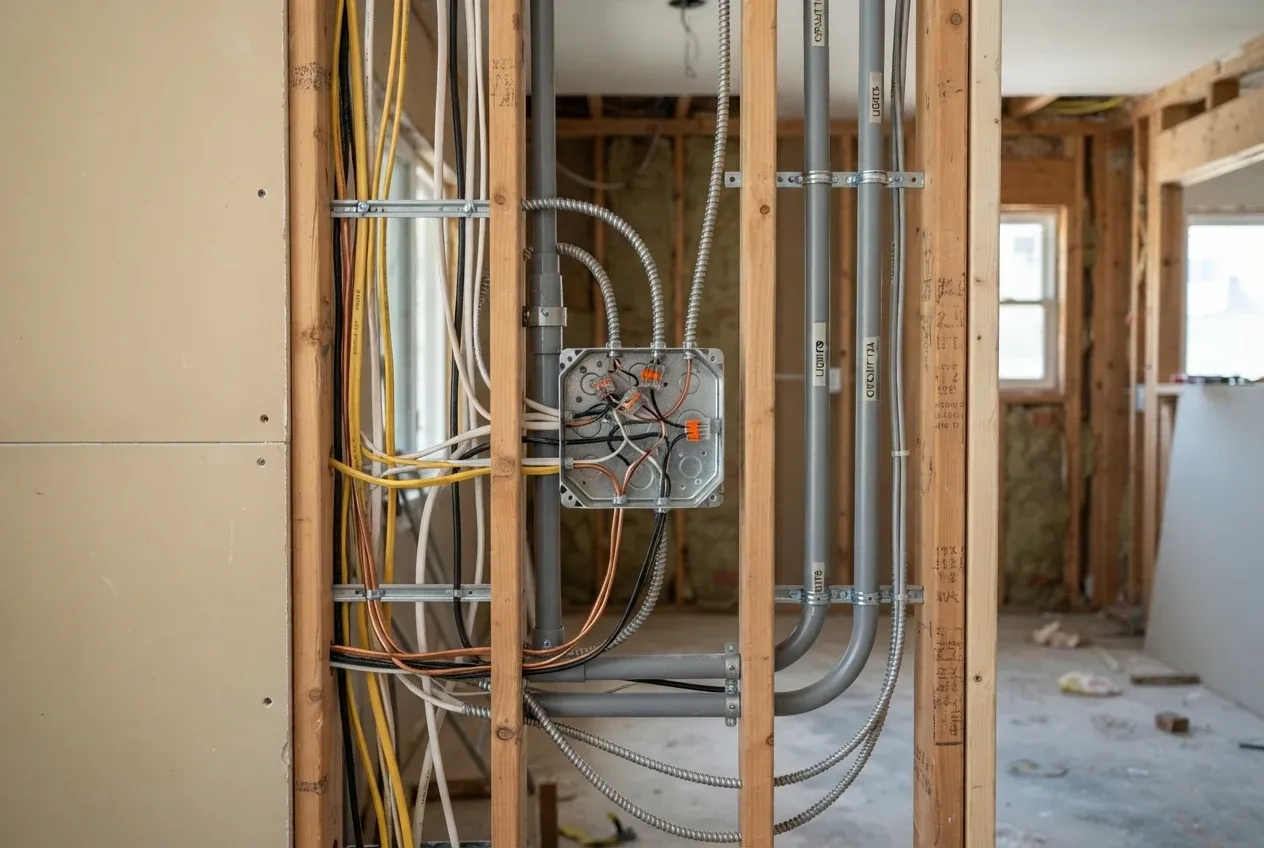
Rewiring replaces the wiring itself rather than the devices connected to it. It is the appropriate answer when the conductors, their insulation, or the wiring method have reached the end of their service life.
Get connected
Free to use. We route your call to an independent licensed electrician who covers your ZIP code.
Rewiring is about the conductors, not the devices
Rewiring and repair are worth separating. Replacing outlets, switches, and fixtures addresses the visible parts of the system. Rewiring replaces the cable in the walls. The part that is expensive to reach and that determines whether the circuits are safe and adequate.
That distinction matters because replacing devices on deteriorated wiring produces a system that looks modern and is not. New outlets connected to brittle cloth-insulated conductors are still brittle cloth-insulated conductors.
Housing era is a useful guide
The wiring method used in a home tracks closely to when it was built. Construction before roughly 1950 often means knob-and-tube. The 1950s and early 1960s brought cable with limited or no grounding. The window from roughly 1965 to 1973 is when aluminium branch-circuit wiring was widely installed. From the mid 1970s onward, grounded copper cable became standard, with GFCI and later AFCI requirements expanding over subsequent code cycles.
This is a guide rather than a diagnosis. Homes get modified. But it tells you what to look for.
The best time to rewire
If you are already opening walls for a renovation, the marginal cost of rewiring drops substantially. Access is the expensive part of the job, and a renovation provides it. Homeowners who rewire separately a year after a kitchen remodel usually pay twice for the same access.
Signs you may need this
- 01The home has knob-and-tube wiring, typical of construction before around 1950
- 02Two-prong ungrounded outlets throughout
- 03Cloth-insulated cable with insulation that is brittle or crumbling
- 04Aluminium branch-circuit wiring, most common in homes built roughly 1965 to 1973
- 05Repeated faults on multiple circuits rather than one
- 06Insurance difficulties related to the wiring type
- 07A major renovation that opens walls anyway
Common problems
What actually goes wrong
Knob-and-tube wiring
An early method with no ground conductor, relying on air circulation around the conductors for cooling. It becomes hazardous when buried in insulation added later, which is extremely common. Many insurers will not cover homes that still have active knob-and-tube.
Deteriorated cloth and rubber insulation
Older cable insulation becomes brittle with age and heat. It cracks when disturbed, exposing conductors inside boxes and walls. There is no repair for the insulation itself.
Aluminium branch-circuit wiring
Used widely in branch circuits during a window in the late 1960s and early 1970s. Aluminium expands and contracts more than copper, which loosens connections at devices over time, and loose connections under load generate heat. Remediation options range from approved connectors at every device to full replacement.
Ungrounded circuits
Two-wire circuits with no equipment ground. Surge protection does not work properly without a ground, and three-prong appliances lose their protective path.
Circuits extended repeatedly over decades
Homes accumulate additions. At some point a circuit has more devices, longer runs, and more junctions than it was designed for.
How the work usually goes
- Step 01
Assessment and scope
The electrician establishes what wiring types are present and where, which determines whether partial or whole-house rewiring is appropriate.
- Step 02
Permit and planning
Rewiring is permitted and inspected work. Planning covers circuit layout, where new circuits are needed, and panel capacity.
- Step 03
Access planning
Deciding routes that minimise damage to finished surfaces. This is a large part of the cost and worth discussing in detail.
- Step 04
Rough-in
New cable is run and boxes set, with the work inspected before walls are closed.
- Step 05
Devices and termination
Outlets, switches, and fixtures are fitted and terminated, and the panel connections made.
- Step 06
Final inspection
The jurisdiction inspects before the work is signed off.
Read this first
Safety
considerations
- 01
If your home has knob-and-tube wiring, do not add insulation over it. Removing the air circulation it depends on is a genuine fire risk.
- 02
Aluminium branch wiring is not automatically dangerous, but the connections need proper treatment with approved devices. Standard outlets and switches are not rated for direct aluminium connection.
- 03
Brittle insulation cracks when disturbed. Handling old cable to investigate can create a hazard where there was not one.
What affects the cost
We do not
publish prices.
Electricians in the network set their own rates. Quoting a figure on someone else's behalf would not be honest. These are the factors that move the number.
- 01Square footage and number of circuits
- 02Whether it is whole-house or limited to specific circuits
- 03Construction type, since plaster and lath is considerably harder than drywall
- 04Accessibility of attic, basement, and crawl spaces for running cable
- 05Whether the panel also needs upgrading, which is common
- 06Drywall or plaster repair and redecoration afterwards
- 07Local permit and inspection fees
- 08Whether the home is occupied during the work
Straight answers
Home Rewiring questions
Does the whole house need rewiring, or just parts?
It depends entirely on what is present. Many homes have been partly rewired already, a kitchen renovation here, an addition there, leaving original wiring only in specific areas. A proper assessment establishes what is where, and partial rewiring of the affected circuits is often the appropriate and considerably cheaper answer.
Do we need to move out during rewiring?
Not usually, though it depends on scope and your tolerance. Work is normally staged so that power is restored to occupied areas each evening. Whole-house rewiring is disruptive, walls opened, dust, rooms unavailable in turn, but most households stay in place. Your electrician can stage the work around that if you tell them up front.
Is aluminium wiring something I have to replace?
Not necessarily. Aluminium branch wiring can be remediated using approved connectors at every device and junction, which is significantly cheaper than full replacement and is a recognised approach. Full replacement is the more thorough option. Which one suits you depends on the condition of the existing connections and on what your insurer requires. Note that this concerns aluminium branch circuits, not the aluminium service conductors that are still standard and entirely normal.
Will rewiring damage my walls?
Some access is unavoidable. Experienced electricians route through attics, basements, and crawl spaces wherever possible and open walls only where necessary, but a whole-house rewire in a home with no accessible routes will mean cutting. Ask for the access plan before work starts, and clarify whether patching and redecoration are included in the quote, often they are not.
How do I know when my home was wired?
The construction date is a starting point but not conclusive, since many homes have been partly rewired. What matters is what is physically present. An electrician can determine this by examining the panel, accessible junction boxes, and outlets. The wiring method and cable markings identify both type and approximate era.

Get connected
One call. One electrician. Yours.
Free to use. We connect you with an independent licensed electrician who covers your ZIP code, then step out of the way.
A free connection service. Electricians in our network are independent and responsible for their own work.