Service
Surge Protection
Most damaging surges do not come from lightning. They come from inside the home and from routine utility switching, and they accumulate rather than arriving all at once.
Get connected
Free to use. We route your call to an independent licensed electrician who covers your ZIP code.
What a surge actually is
A surge is a brief overvoltage, microseconds to milliseconds, riding on the normal supply. Modern electronics tolerate these poorly. What makes them insidious is that damage is usually cumulative. A device rarely fails on a single event; it fails after enough of them have degraded it, at which point the cause is invisible and gets attributed to bad luck or poor quality.
Layered protection
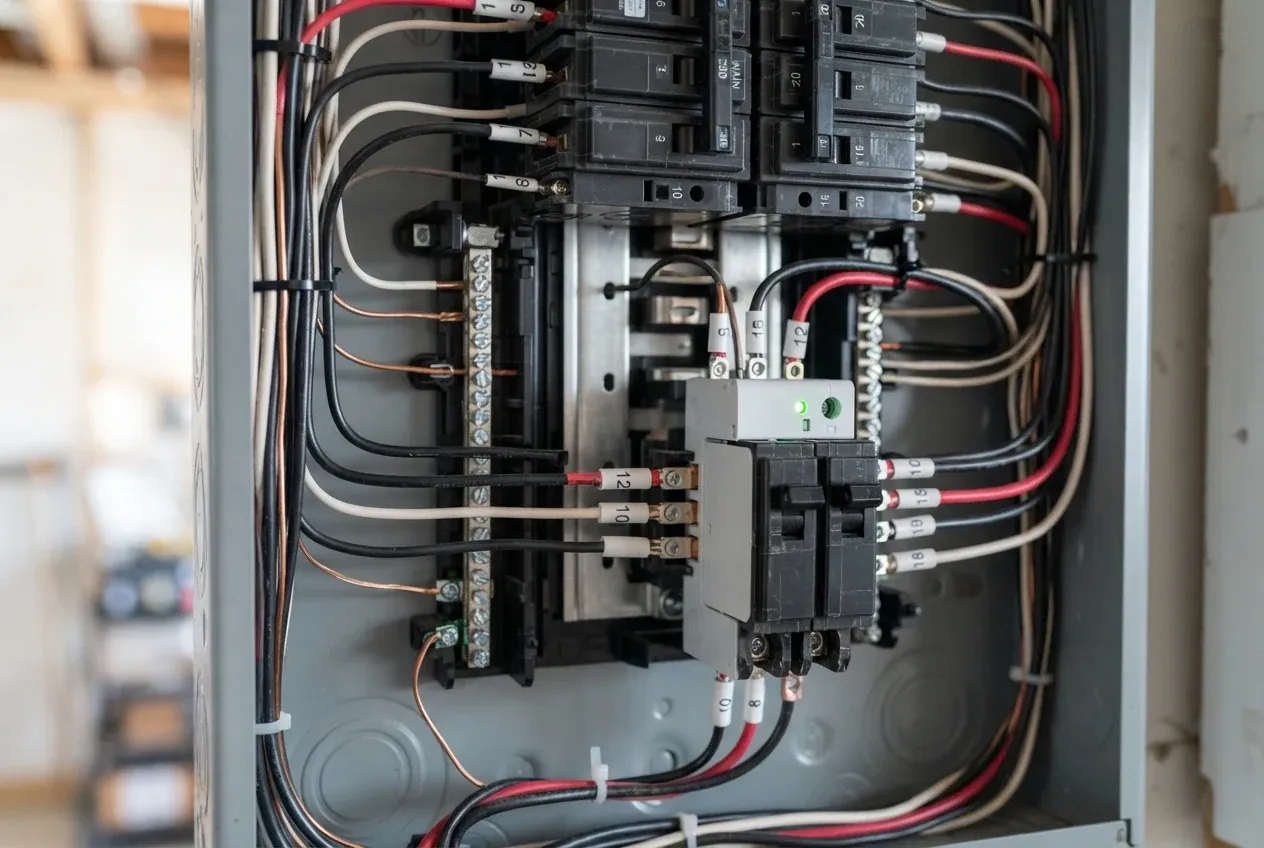
The accepted approach is layers. A device at the service entrance reduces the magnitude of what enters the building. Point-of-use devices handle what gets past it, and also protect against surges generated inside the home downstream of the panel.
Neither layer alone is complete. Panel-level protection does not stop the transient your own air conditioner produces on a shared circuit. Point-of-use protection does nothing for your furnace.
Grounding comes first
This is the part that gets missed. Surge protective devices work by diverting excess voltage to ground. If the grounding electrode system is inadequate, or the circuit is ungrounded, there is nowhere for that energy to go.
In older homes this frequently means the right recommendation is to address grounding and bonding before fitting surge protection. Otherwise you are paying for a device that cannot do what it is for.
Signs you may need this
- 01Electronics failing more often than seems reasonable
- 02Lights that dim or flicker when large appliances start
- 03A home with significant connected electronics, appliances, or smart devices
- 04Frequent utility switching, storms, or an area with overhead distribution
- 05No surge protective device at the panel
- 06Ungrounded circuits, which prevent surge protection from working at all
Common problems
What actually goes wrong
Internally generated surges
The majority of surge events originate inside the building: motors in air conditioning, refrigeration, and laundry equipment produce voltage spikes each time they cycle. These are small individually and cumulative in effect.
Utility switching transients
Routine grid switching, capacitor banks, and reclosing after a fault all produce transients on the incoming supply.
Lightning
The dramatic case and the least common. A direct strike overwhelms most protection, but nearby strikes induce surges that a properly installed device handles.
Point-of-use protection alone
A power strip protects what is plugged into it. It does nothing for hardwired equipment: heating and cooling systems, ovens, dishwashers, garage door openers, or the increasing amount of electronics inside modern appliances.
Missing or inadequate grounding
Surge protection works by diverting excess voltage to ground. Without a proper ground path, a surge protective device cannot do its job. This is why ungrounded homes need the grounding addressed first.
How the work usually goes
- Step 01
Verify grounding and bonding
The electrician confirms the grounding electrode system and bonding are adequate, since surge protection depends entirely on them.
- Step 02
Assess the panel
Confirming there is space and a suitable connection point for a surge protective device.
- Step 03
Install at the service
Fitting a device at the panel with the shortest practical conductor length, since lead length materially affects performance.
- Step 04
Add point-of-use protection
Layering protection at sensitive equipment, since panel-level devices reduce rather than eliminate what gets through.
- Step 05
Confirm indication
Surge protective devices have status indicators showing whether they are still functioning. Knowing where it is and what it should show matters.
Read this first
Safety
considerations
- 01
Surge protection requires a proper ground to function. Fitting a device to an inadequately grounded system provides little protection.
- 02
Surge protective devices wear out. They absorb energy over their life and eventually stop protecting, usually without any obvious symptom other than the status indicator.
- 03
A device fitted with excessive conductor length performs measurably worse. Lead length is part of the installation quality.
What affects the cost
We do not
publish prices.
Electricians in the network set their own rates. Quoting a figure on someone else's behalf would not be honest. These are the factors that move the number.
- 01Device rating and quality
- 02Whether the panel has space and a suitable connection point
- 03Whether grounding or bonding needs correcting first, which is common in older homes
- 04How many point-of-use devices are added
- 05Whether the panel type accepts a breaker-style device or needs an external enclosure
Straight answers
Surge Protection questions
Is a power strip surge protector enough?
For the individual devices plugged into it, it provides useful protection. For the house, no. It does nothing for anything hardwired, heating and cooling equipment, ovens, dishwashers, garage door openers, the control electronics inside modern appliances. Layered protection is the sound approach, a device at the panel to reduce the magnitude of what enters, plus point-of-use protection at sensitive equipment.
How long does a surge protective device last?
There is no fixed lifespan. Devices absorb energy over time and degrade with cumulative exposure, so a home in an area with frequent transients wears one out faster. Most have a status indicator, and checking it periodically is worthwhile because a failed device gives no other sign. After any significant surge event, check it.
Do I need surge protection if I have no lightning in my area?
Yes, arguably more than you would think. Lightning is the least common source. Motor-driven appliances inside your own home produce transients every time they cycle, and utility switching produces more. Those are the events driving most cumulative electronics wear, and they happen everywhere.
Can a surge protector be added to any panel?
Most modern panels accept either a breaker-style device or an externally mounted one connected to a two-pole breaker. The constraints are available space and the panel type: some obsolete panels have no compatible options, which is one of several reasons those panels tend toward replacement. Grounding also needs verifying first.

Get connected
One call. One electrician. Yours.
Free to use. We connect you with an independent licensed electrician who covers your ZIP code, then step out of the way.
A free connection service. Electricians in our network are independent and responsible for their own work.